
Calculate A Planet's Orbital Period
Does mass affect orbital speed. Calculate the distances of Venus and Mars from the Sun.

New Moon Discovered Around The Planet Neptune Tallying Up The Planet S Moon To 14 Hubble Space Telescope Hubble Milky Way Galaxy
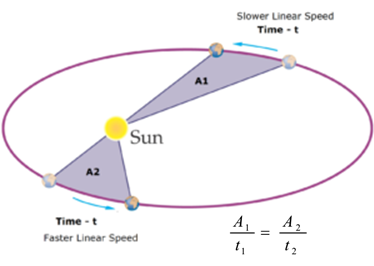
Planetary Physics Keplers Laws of Planetary Motion Keplers three laws describe how planetary bodies orbit the Sun.

Calculate a planet's orbital period. The orbits of all large planets are rather close to circles. The formula to calculate the orbital period of a satellite around the central body is T 3π G ρ Where T is the orbital period. Smallest distance from the sun the planet finds itself at during its trajectory.
That of Earth for instance has e00167 3 The mean anomaly M an angle growing at a steady rate increasing by 360 degrees each orbit. Click on CALCULATE and the answer is 2371900 seconds or 27453 days. G is the gravitational constant.
Keplers third law or Keplers laws planetary motion describes how a planet orbits around another. M is the mass of the central object. I have a homework question asking me to calculate the mass of a planet given the semimajor axis and orbital period of its moon.
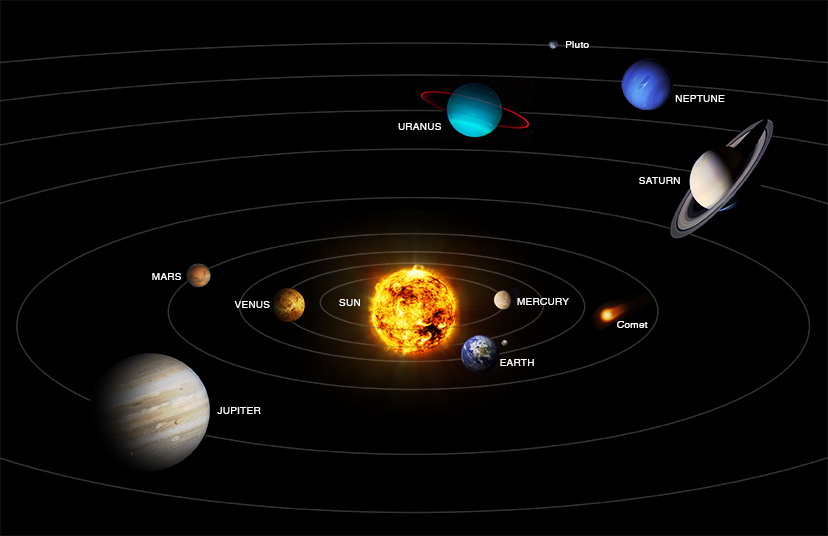
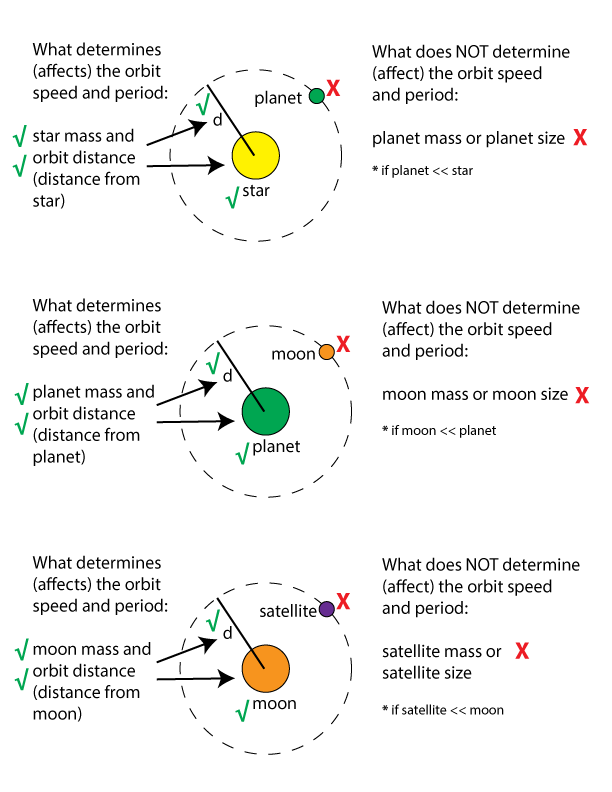
The square of the orbital period of a planet is proportional to the cube of the semi-major axis of its orbit. No the mass of a body orbiting a second body is irrelevant in determining orbital parameters as long as the first body is much larger than its satellite. The precise amount of time in Earth days it takes for each planet to complete its orbit can be seen below.
The following formula is used to calculate the orbital period. This method gives a precise and accurate value of the astronomical objects mass. I think Im meant to assume the moons mass is negligible because otherwise thats impossible as far as Im aware.
What determines orbital period. You can check this calculation by setting the masses to 1 Sun and 1 Earth and the distance to 1 astronomical unit AU which is the distance between the Earth and the Sun. G is the gravitational constant.
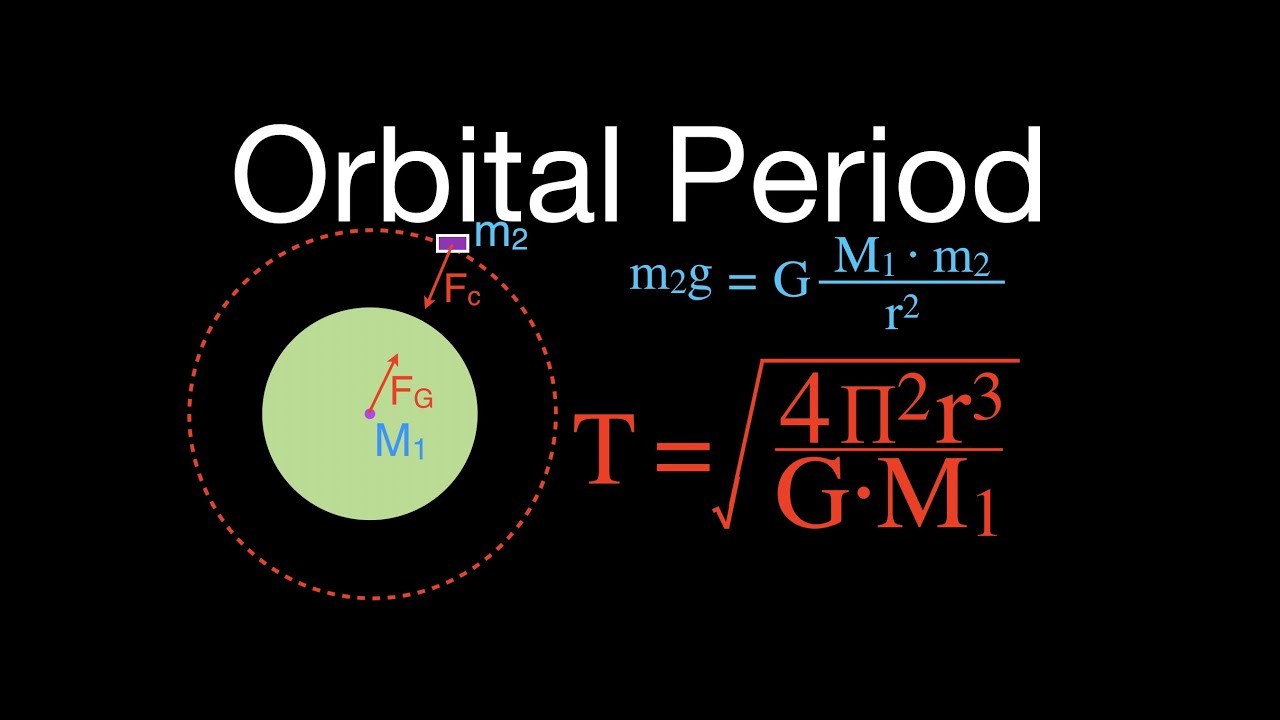
R is the distance between objects. The orbit of every planet is an ellipse with the Sun at one of the two foci. Hence from the above equation we only need distance between the planet and the moon r and the orbital period of the moon T to calculate the mass of a planet.
The orbital period can be calculated using Keplers 3rd law which states that the square of the orbital period is proportional to the cube of the average distance from the sun. For problems involving orbits around the Sun it is convenient to use Earth as the standard. 8797 days 02 years Venus.
Given those numbers M is readily calculated for any time t. Show activity on this post. Because the value of π and G is constant and known.
A line joining a planet and the Sun sweeps out equal areas during equal intervals of time. Second Law of Kepler Credit. T2 prop R3 Where T is the orbital period and R is the bodys average distance from the sun or the semi-major axis.
You can calculate the speed of a satellite around an object using the equation. Earths year of 36525 days 1 and Earths average distance from the Sun 92900000 miles would also equal 1 this distance is also known as an astronomical unit. Click on the TIME button.
If you know the satellites speed and the radius at which it orbits you can figure out its period. Thus- h 2 A2 1 e2. Unsurprisingly the the length of each planets year correlates with its distance from the Sun as seen in the graph above.
You will see an orbital period close to the familiar 1 year. To calculate the period τ of the elliptic orbit we recall that the area of an ellipse equals πAB πA2sqrt1-e2 and that the area swept out per time is h2 from Keplers 2nd law. The time periods of revolutions of planets Venus and Mars are 2247 days and 6870 days respectively where day means a terrestrial day.
The square of the orbital. They describe how 1 planets move in elliptical orbits with the Sun as a focus 2 a planet covers the same area of space in the same amount of time no matter where it is in its orbit and 3 a planets orbital period is proportional to the size of its orbit its semi-major. Enter the radius and mass data.
The period of the Earth as it travels around the sun is one year. So scientists use this method to determine the planets mass or any other planet-like objects mass. In the original equation the mass of the satellite is included as well but its so much.
How do you calculate the orbital period of a planet. The simplest way to calculate orbital period of a planet is by taking the time difference between two moments at which it is observed to be in the same place in the sky. You can see this reflected in Keplers third law.
Without Using The Calculator t 2 4 π 2 r 3 G m t 2 4 π 2 386000000 3 6674x10-11 60471x10 24 t 2 227x10 27 404 14 t 2 5626000000000 time 2372000 seconds. By observing the time between transits we know the orbital period. Radius of the orbit of the Earth r E 1496 10 8 km Time period of Earth T E 3653 days Time period of Venus T E 2247 days Time period of Mars T M 6870 days.
P t 2 t 1. R Satellite Mean Orbital Radius T Satellite Orbit Period M Planet Mass G Universal Gravitational Constant 66726 x 10-11 N-m 2 kg 2. Mercurys orbital period would then be 8836525 or 241 Earth years.
P SQRT 4pir3G M Where p is the orbital period. Orbital Period Formula. Keplers Third law can be used to determine the orbital radius of the planet if the mass of the orbiting star is known R3T2MstarMsun the radius is in AU and the period is in earth years.
Using Keplers 3rd law we get an orbital period of about 283 years. M M0 360tT where M0 is the value of M at time t0 and T is the orbital period.

A Typical Textbook Illustration Of A Planet S Orbit And B Earth S Download Scientific Diagram
What Are The Steps Involved In Calculating Orbital Period Quora
Orbital Speed Of Planets Gcse Physics Youtube
Period Of Revolution Of Planet Using Keppler S Laws Of Orbital Motion
Is A Planet S Orbital Period Related To The Planet S Size Socratic

Question Video Calculating The Mass Of A Star Given A Planet S Orbital Period And Radius Nagwa
Gravity Applications

How Was Neptune Discovered How Did It Get Its Name What Is Neptune Composed Of Which Color Is Neptune How Many Moons And Neptune Facts Neptune Space Facts

Orbits In The Solar System Astronomy
Gravitation 6 Of 17 Calculating The Orbital Period Of A Satelite Youtube

Tau Ceti System Astronomy Science Diy Solar Eclipse Viewer Solar System

Question Video Calculating Orbital Radius Nagwa
What Planet Is Closest To Mars Quora
How Is Orbit Speed Calculated Quora

Posting Komentar untuk "Calculate A Planet's Orbital Period"