
The Planets Orbital Velocity
Orbital velocity refers to the velocity required by satellites natural or artificial to remain in their orbits. At orbital velocity Earths or any celestial bodys gravitational force pulling a moon towards its center where all its mass lies emulates the tension you exert on one end of a string that causes a stone attached to the other end to swing in circles around you.

Digital Mercury Poster In 2021 Mercury Mercury Planet Planet Painting
It becomes the centripetal force that drives a moon or satellite around it.

The planets orbital velocity. The orbital velocity is directly proportional to the mass of the body for which it is being calculated and inversely proportional to the radius of the body. Neptune travels around the sun at a speed of 543 kms or 12146 miles per hour. The orbital velocity of a planet relative to that of Earths is then the relative radius divided by the relative length of the year.
Learn About Orbital Velocity and How Orbital Velocity Impacts Space Travel - 2021 - MasterClass. Where do planets and moons get orbital velocity from. The orbit it is imperative to remember is not a perfect circle but.
The velocity with which the test mass orbits around a source mass is known as orbital velocity v o v_o v o when the test mass is orbiting around the source mass in a circular path of radius r having a centre of the source mass as the centre of the circular path the centripetal force is provided by the gravitational force as it is always an attracting force having its direction pointed. Therefore Mercury is the fastest planet and Moon is much slower than the planets. The instantaneous velocity of an object moving in an elliptical orbit due to the influence of gravity Formula.
The orbital velocity is 2πRT where R is the average radius of the orbit and T is the length of the year. All objects in the Solar System or indeed in any stellar system or galaxy get their orbital velocity and their spin from the net angular momentum of the molecular cloud of gas and dust that gravitationally collapsed to create the system. Using the normal symbols for perihelion distance q and aphelion distance Q note that Figure III2 tells us that q a 1 e and Q a 1 e.
The laws modified the heliocentric theory of Nicolaus Copernicus replacing its circular orbits and epicycles with elliptical trajectories and explaining how planetary velocities vary. Orbits of the Planets. Angular momentum is conserved so it has to end up somewhere.
The orbit or the orbital pathway whether elliptical or circular displays a balance between the inertia of the satellite which makes it move in a straight line with the gravity of. What Is Orbital Velocity. Looking at the speeds of the planets in our solar system when traveling around the sun and their distances from it or using Keplers third law it seems that when a planets distance is doubled its velocity drops to about 707 of its previous value.
We can calculate the orbital velocity with the help of this below formula. Orbital velocity refers to the velocity required by the satellites to remain in their orbits. This orbital speed results from the mass of the central body the Sun or in case of the Moon it is Earth the mass of the orbiting body and from the radius of the orbit the smaller the radius the higher is the velocity.
Although this is a very high rate of speed Neptune still has the slowest orbital velocity of any of the planets. As you read this Earth is surrounded by various satellites hovering miles above our heads. Where V orbit Orbital velocity kms G Gravitational constant m 3 s 2 kg M Mass of the body at center kg R Radius of the orbit m.
The orbit of a planet is an ellipse with the Sun at. Earths orbital velocity near its surface is around eight kilometres five miles per second if the air resistance is disregarded. The object could be considered anything from an artificial satellite orbiting around a planet a planet orbiting around a start etc.
Where G gravitational constant M mass of the body at centre R radius of the orbit. The orbital pathway being either elliptical or circular displays a balance between the inertia of the satellite which helps to make it move in a straight line with the gravity of the planet which in turn pulls the satellite closer and closer to the planet. Orbital Velocity Formula is applied to calculate the orbital velocity of any planet if mass M and radius R are known.
The three laws state that. The vis viva equation III30 describes the variation of orbital velocity with distance from the central mass. V 2 GM2r - 1a where G 667 x 10-11 N m 2 kg 2 M is the mass of the planet or object to be orbited r is the radial distance of the orbiting object from the center of the planet or object to be orbited at a given moment.
Describe how orbital velocity is related to conservation of angular momentum Determine the period of an elliptical orbit from its major axis Using the precise data collected by Tycho Brahe Johannes Kepler carefully analyzed the positions in the sky of all the known planets and the Moon plotting their positions at regular intervals of time. Estremely stable with current limits of radial velocity accuracy 40 cms for planets orbiting relatively bright stars V12 HARPS-north Based on the HARPS spectrograph installed in 2012 at the Italian national telescope TNG 35m La Palma Spain Extends the capabilities of. A planets orbit is fairly circular so its orbital speed is approximately equal to the speed of a perfectly circular orbit v2GMmr.
All objects in the Solar System or indeed in any stellar system or galaxy get their orbital velocity and their spin from the net angular momentum of the molecular cloud of gas and dust that gravitationally collapsed to create the system. Begingroup Yes you need an initial velocity. The orbital velocity formula is given by It is given by.
For an elliptical orbit you can use the vis-viva equation. Our own moon also remains above the planet at all hours. In astronomy Keplers laws of planetary motion published by Johannes Kepler between 1609 and 1619 describe the orbits of planets around the Sun.

Mercury Planets Mercury Planet Planets Mercury

Kepler S Third Law Basic Physics Lessons Teaching Chemistry Chemistry Lessons
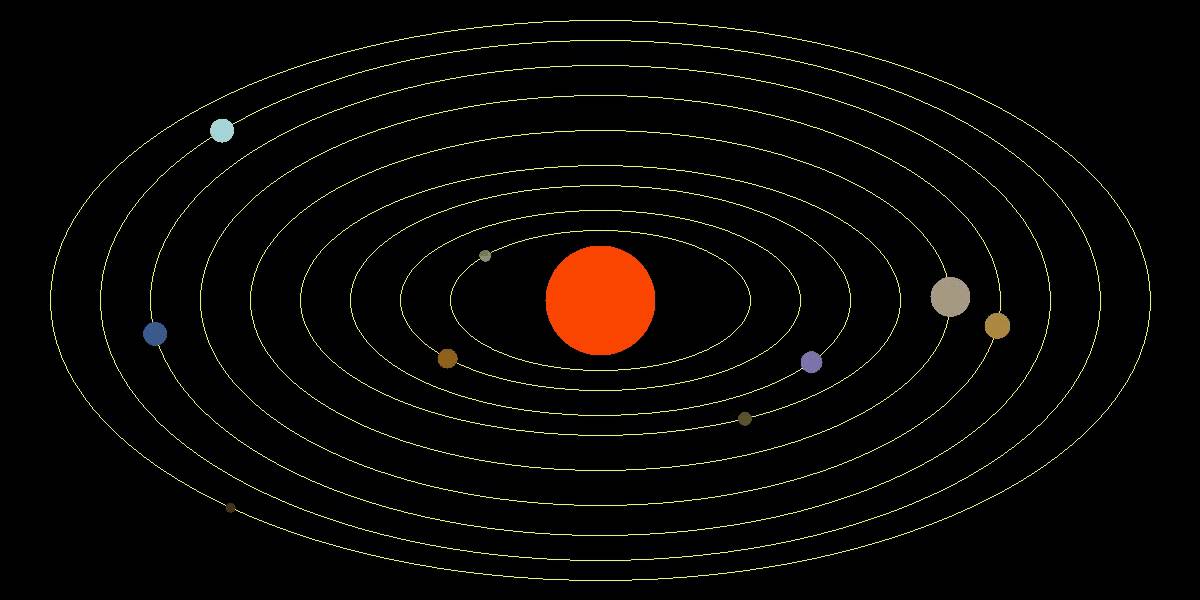
Solar System Planet Movement Animation Solar System Projects Solar System Solar System Planets

Planets Zoom Astronomy Earth For Kids Astronomy Planets

This Is How The Moon Orbits Earth Using Real Data For The Month Of April 2020 Video Moon Orbit Space And Astronomy Nasa Solar System

This Chart Explains How Long A Year Is On Each Planet Show This When Explaining The Way Planets Orbit The Nasa Solar System Earth And Space Science Nasa Earth

Johannes Kepler Laws Of Planetary Motion Elliptical Orbits Cause Planetary Motion To Vary Or Earth And Space Science High School Astronomy Elementary Science

5 Facts Of Ice Cold Planet Uranus Infographic Earth How Uranus Space Science Uranus Planet

Pin On Orrery

Relative Orbital Velocities Planet Motions Rotations And Tilts To Scale Planets Velocity Motion
Digital Neptune Poster In 2021 Neptune Neptune Planet Iphone Wallpaper Nasa

Exoplanets Graphed By Size Vertical And Orbit Horizontal Cold Gas Giants And Rocky Planets We Expected The Others Not Planets Space Telescope Gas Giant

Orbital Speed Of Planets In Order Rotational Speed Comparison Orbital Speed Planets Speed

Orbits Of The Moons And Planets Solar System Gif Astronomy Our Solar System

Posting Komentar untuk "The Planets Orbital Velocity"